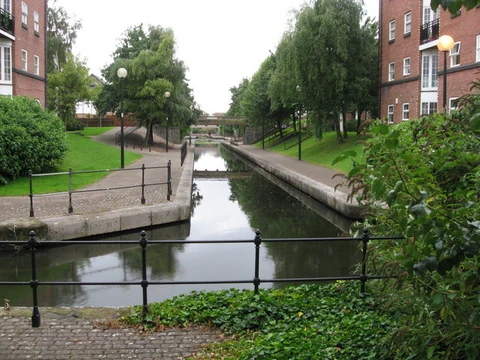
Trollhätte Canal
Swedish canal connecting Göta river to Lake Vänern.
The Trollhätte Canal, known in Swedish as Trollhätte kanal, is a waterway in Sweden that links the Göta river to Lake Vänern. It first opened in 1800 and was designated a national monument in 2004. Together with the Göta Canal, it creates a 390 km route across Sweden that connects the Kattegatt area of the North Sea to the Baltic Sea. This combined waterway is called Sweden's Blue Ribbon (Sveriges Blå Band). Despite a common misconception, it is wrong to view this route as part of the larger Göta Canal; the Trollhätte Canal and the Göta Canal are entirely distinct from each other.
The canal stretches 82 km, but only 10 km of that is man-made; the rest follows the natural riverbed of the Göta Älv. Its highest point is at Lake Vänern, 44.10 meters above sea level. Six locks line the canal heading downstream toward Gothenburg: Brinkebergskulle sluss (6 m) in Vänersborg; Tvåan (9 m) in upper Trollhättan; Slusstrappan (23 m), a triple lock staircase in lower Trollhättan; and Ströms sluss (6 m) in Lilla Edet, 49 km from Göteborg.
Cargo traffic runs nearly year-round, pausing only for short winter periods when locks undergo maintenance or are blocked by ice. The canal can handle ships up to 4,000 tonnes, but cargo volumes have steadily dropped since the early 2000s: in 2015, freight amounted to 1.5 million tonnes, down from 3.5 million tonnes in 1990. A study points to several reasons, including competition from road and rail transport, as well as limits from the canal’s current infrastructure. The existing locks were built in 1916 and are too small for modern freighters, restricting throughput. Their age is also a factor—constructed with century-old technology and materials, they struggle against water and ice despite regular upkeep, and are estimated to become unsafe after 2030. In response, Swedish transport authorities plan to renovate the canal infrastructure between 2025 and 2026, with completion expected in 2030 to 2032.
Ships that fit the canal’s maximum dimensions are classified as Vänermax. These measurements are: length 88 m, beam 13.40 m, draft 5.40 m, and vertical clearance 27 m.
- length
- 82 km (10 km manmade)
- highest_point
- Lake Vänern at 44.10 m a.s.l.
- number_of_locks
- 6
- max_ship_tonnage
- 4,000 tonnes
- opened
- 1800
- national_monument
- 2004
- cargo_volume_2015
- 1.5 million tonnes
Lore & Background
The Trollhätte Canal is 82 km long, albeit only 10 km of it is manmade, the rest of its watercourse it was laid out through the riverbed of the Göta Älv river. The highest point of the Trollhätte Canal is at the Lake Vänern – 44.10 m a.s.l. The canal has six locks (downstream towards Gothenburg): Brinkebergskulle sluss (6 m) – Vänersborg; Tvåan (9 m) – Trollhättan upper; Slusstrappan (23 m) – Trollhättan lower, triple lock staircase; and Ströms sluss (6 m) – Lilla Edet, 49 km from Göteborg. The canal is open for cargo traffic nearly all year round except short periods in winter when its locks are subject to maintenance or affected by ice. The canal allows ships up to 4000 tonnes to pass through. However the statistics show that from the beginning of the 21st century the cargo traffic through the canal is in steady decline: in 2015 the volume of freight transferred through the canal amounted to 1.5 million tonnes while in 1990 it was as large as 3.5 million tonnes. A relevant study suggests this decline is due to a number of factors. One of them is competition from road and rail transportation, but another is due to the constraints of the current infrastructure of the canal.
Reader's Guide
The current locks of the canal were built in 1916. They are not large enough for modern day freighters, thus they do not have sufficient throughput capacity. Another factor is the age of the locks per se. They were built using technology and materials more than a hundred years ago. Despite regular maintenance they struggle to sustain the effects of water and ice. It is estimated that the locks could not be safely used after 2030. In this regard the Swedish transport authorities are planning in 2025-2026 to proceed with the renovation of the canal infrastructure which is to be finished in 2030-2032. Ships classified as Vänermax are of the maximal measurements that will fit through the canal as follows: Length: 88 m; Beam: 13.40 m; Draft: 5.40 m; Vertical clearance: 27 m.
Did You Know?
- The Trollhätte Canal is 82 km long, but only 10 km of it is manmade; the rest follows the riverbed of the Göta Älv river.
- The canal's highest point is at Lake Vänern, 44.10 m above sea level.
- The current locks were built in 1916 and are estimated to be unsafe for use after 2030.
- Cargo traffic through the canal declined from 3.5 million tonnes in 1990 to 1.5 million tonnes in 2015.
- The Vänermax ship class is defined by the canal's maximum dimensions: 88 m length, 13.40 m beam, 5.40 m draft, and 27 m vertical clearance.
Frequently Asked Questions
What is the Trollhätte Canal and where is it located?
The Trollhätte Canal is a Swedish waterway that links the Göta river to Lake Vänern. It was opened to navigation in 1800 and stretches 82 kilometres in total, of which roughly 10 kilometres are manmade.
How many locks does the Trollhätte Canal have and what is the maximum ship size allowed?
The canal features six locks to manage the elevation change up to Lake Vänern, which sits at 44.10 metres above sea level. Vessels using the waterway are limited to a maximum tonnage of 4,000 tonnes.
Is the Trollhätte Canal the same thing as the Göta Canal?
No, despite a common misconception, the two are entirely separate waterways with different routes and histories. They are often grouped together because, combined, they form a continuous 390-kilometre link between the Kattegatt (North Sea) and the Baltic Sea, a route nicknamed Sweden's Blue Ribbon.
What is the highest point on the Trollhätte Canal route?
The route peaks at Lake Vänern, which sits at 44.10 metres above sea level. This elevation makes the six-lock system essential for raising or lowering vessels as they transit the canal.
When was the Trollhätte Canal designated a national monument?
Sweden officially proclaimed the Trollhätte Canal a national monument in 2004, recognising its historical and engineering significance. The designation came more than two centuries after the canal first opened in 1800.
More in Canals And Waterways 1-24
Spotted an error? Know more?
This is a living reference — every entry is fact-audited, and reader corrections feed straight into our audit queue. Suggest an edit · See this site's audit record