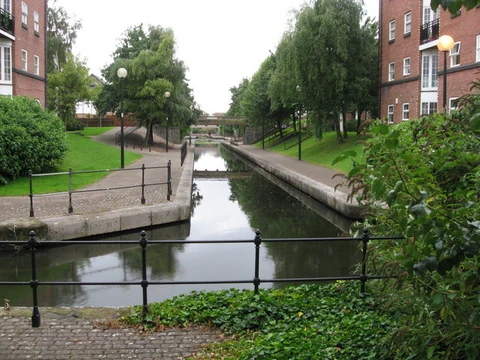
Göta Canal
Swedish canal linking west coast to Baltic Sea.

via Wikipedia: Göta Canal · see source
The Göta Canal is a Swedish canal constructed in the early 19th century, linking a number of lakes and rivers to provide a route from Gothenburg on the west coast to Söderköping on the Baltic Sea. It is part of a larger waterway 390 km long, dubbed Sweden's Blue Ribbon, though the Göta Canal and the Trollhätte Canal are completely separate entities.
- Length
- 190 km (120 mi)
- Constructed
- 1810–1832
- Number of locks
- 58
- Max vessel dimensions
- 30 m long, 7 m wide, 2.8 m draft
- Max depth
- about 3 m (9.8 ft)
- Speed limit
- 5 knots
- Budget
- 24 million Swedish riksdalers
Verified Timeline
Lore & Background
The idea of a canal across southern Sweden was first put forward in 1516 by Hans Brask, bishop of Linköping, but was not acted upon until the start of the 19th century by Baltzar von Platen, a German-born former officer in the Swedish Navy. He organised the project and obtained the necessary financial and political backing. His plans attracted the enthusiastic backing of the government and the new king, Charles XIII, who saw the canal as a way of kick-starting the modernisation of Sweden. Von Platen himself extolled the modernising virtues of the canal in 1806, claiming that mining, agriculture and other industries would benefit from 'a navigation way through the country.' The project was inaugurated on 11 April 1810 with a budget of 24 million Swedish riksdalers. It was by far the greatest civil engineering project ever undertaken in Sweden up to that time, taking 22 years of effort by more than 58,000 workers. Much of the expertise and equipment had to be acquired from abroad, notably from Britain, whose canal system was the most advanced in the world at that time. The Scottish civil engineer Thomas Telford, renowned for his design of the Caledonian Canal in Scotland, developed the initial plans for the canal and travelled to Sweden in 1810 to oversee some of the early work on the route. Many other British engineers and craftsmen were imported to assist with the project, along with significant quantities of equipment - even apparently mundane items such as pickaxes, spades and wheelbarrows.
Reader's Guide
The Göta Canal was officially opened on 26 September 1832. Von Platen himself did not live to see the completion of the canal, having died shortly before its opening. Bishop Hans Brask's original justifications for the canal's construction were the onerous Sound Dues imposed by Denmark–Norway on all vessels passing through the narrow Øresund channel between Sweden and Denmark and the trouble with the Hanseatic League. The canal enabled vessels travelling to or from the Baltic Sea to bypass the Øresund and so evade the Danish toll. In 1851, the tycoon André Oscar Wallenberg founded the Company for Swedish Canal Steamboat Transit Traffic to carry goods from England to Russia via the canal. However, it only ran two trips between St Petersburg and Hull via Motala before the Crimean War halted Anglo-Russian trade. After the war ended, the great powers pressured Denmark into ending the four-hundred-year-old tradition of the Sound Dues, thus eliminating at a stroke the canal's usefulness as an alternative to the Øresund. The arrival of the railways in 1855 quickly made the canal redundant, as trains could carry passengers and goods far more rapidly and did not have to shut down with the arrival of winter, which made the canal impassable for five months of the year. By the 1870s, the canal's goods traffic had dwindled to just three major types of bulk goods - forest products, coal and ore, none of which required rapid transportation. Traffic volumes stagnated after that and never recovered. The canal had one major industrial legacy in the shape of Motala Verkstad - a factory established in Motala to produce the machines such as cranes and steam dredgers that were needed to build the canal. This facility has sometimes been referred to as the 'cradle of the Swedish engineering industry'. After the canal was opened, Motala Verkstad focused on producing equipment, locomotives and rolling stock for the newly constructed railways, beginning a tradition of railway engineering that continues to this day in the form of AB Svenska Järnvägsverkstädernas Aeroplanavdelning (ASJA) that was bought by the aeroplane manufacturer SAAB in Linköping. These days the canal is primarily used as a tourist and recreational attraction. Around two million people visit the canal each year on pleasure cruises - either on their own boats or on one of the many cruise ships - and related activities. The canal sometimes is ironically called the 'divorce ditch' (Swedish: skilsmässodiket) because of the troubles that inexperienced couples have to endure while trying to navigate the narrow canal and the many locks by themselves.
Did You Know?
- The canal is 190 km long, of which 87 km were dug or blasted.
- The canal has 58 locks and can accommodate vessels up to 30 m long, 7 m wide, and 2.8 m in draft.
- The project took 22 years and involved more than 58,000 workers.
- Scottish civil engineer Thomas Telford developed the initial plans and travelled to Sweden in 1810 to oversee early work.
- The canal is sometimes ironically called the 'divorce ditch' because of navigation difficulties for inexperienced couples.
Frequently Asked Questions
What is the Göta Canal?
It is a 190-km Swedish waterway that stitches together a chain of lakes and rivers to connect Gothenburg on the west coast with Söderköping on the Baltic Sea.
How many locks does the Göta Canal contain?
The canal features 58 locks along its route, and all traffic must observe a 5-knot speed limit while navigating them.
What are the size limits for vessels on the Göta Canal?
Boats are restricted to a maximum of 30 m in length, 7 m in beam, and 2.8 m of draft, with the canal's depth topping out at roughly 3 m.
When was the Göta Canal built?
Construction ran from 1810 to 1832, placing it squarely in the early nineteenth century as a major Swedish engineering undertaking.
Is the Göta Canal the same thing as Sweden's Blue Ribbon?
No; the Göta Canal is one segment of the 390-km waterway nicknamed Sweden's Blue Ribbon, and it remains a distinct entity from the Trollhätte Canal.
More in Canals And Waterways 1-24
Elsewhere in the Canals And Waterways universe
Spotted an error? Know more?
This is a living reference — every entry is fact-audited, and reader corrections feed straight into our audit queue. Suggest an edit · See this site's audit record